Wednesday, January 21, 2009

Transferring a Patient from the Wheelchair to the Dental Chair

Transfer of the patient from the wheelchair can be a scary experience for both the patient and the inexperienced dentist. Factors that will determine the actual success of the transfer include

  • ·         Whether the patient is able to transfer himself or requires assistance
  • ·         The Ability of the care giver to give help
  • ·         The skill and experience of the dental staff

Keeping in mind the above mentioned parameters the National Institute of Dental and Craniofacial Research (NIDCR) has proposed the following six steps to a safe wheelchair transfer

STEP 1: Determine the patient's needs

 Ask the patient or caregiver about

a)      preferred transfer method

b)      patient's ability to help

c)       use of special padding or a device for collecting urine

d)      probability of spasms

Reduce the patient's anxiety by announcing each step of the transfer before it begins.

STEP 2: Prepare the dental operatory 

·         Remove the dental chair armrest or move it out of the transfer area.

·         Relocate the hoses, foot controls, operatory light, and bracket table from the transfer path.

·         Position the dental chair at the same height as the wheelchair or slightly lower. Transferring to

STEP 3: Prepare the wheelchair 

·         Remove the footrests.

·         Position the wheelchair close to and parallel to the dental chair.

·         Lock the wheels in place and turn the front casters forward.

·         Remove the wheelchair armrest next to the dental chair.

·         Check for any special padding or equipment

STEP 4: Perform the two-person transfer

·         Support the patient while detaching the safety belt.

·         Transfer any special padding or equipment from the wheelchair to the dental chair.

·         First clinician: Stand behind the patient. Help the patient cross his arms across his chest. Place your arms under the patient's upper arms and grasp his wrists.

·         Second clinician: Place both hands under the patient's lower thighs. Initiate and lead the lift at a prearranged count (1-2-3-lift).

·         Both clinicians: Using your leg and arm muscles while bending your back as little as possible, gently lift the patient's torso and legs at the same time.

·         Securely position the patient in the dental chair and replace the armrest.

THE TWO-PERSON TRANSFER

First clinician stands behind the patient.

Second clinician initiates the lift.


STEP 5: Position the patient after the transfer

·         Center the patient in the dental chair.

·         Reposition the special padding and safety belt as needed for the patient's comfort.

·         If a urine-collecting device is used, straighten the tubing and place the bag below the level of the bladder.


STEP 6: Transfer from the dental chair to the wheelchair

 Position the wheelchair close to and parallel to the dental chair.

·         Lock the wheels in place, turn the casters forward, and remove the armrest.

·         Raise the dental chair until it is slightly higher than the wheelchair and remove the armrest.

·         Transfer any special padding.

·         Transfer the patient using the two-person transfer (see step 4).

·         Reposition the patient in the wheelchair.

·         Attach the safety belt and check the tubing of the urine-collecting device, if there is one, and reposition the bag.

·         Replace the armrest and foot rests. 

Working on the patient in the Wheelchair

One of the simplest ways to overcome the problem of patient access to the dental chair is by providing the treatment in the wheelchair itself, without transferring the patient. Conventional wheel chair based dentistry usually does not permit sitting down dentistry. The wheelchair is wheeled close to the instrument tray of the dental chair and the safety brakes are applied. The operator then stands behind the patient and is able to perform the necessary procedures.

Though greatly convenient to the patient this form of dentistry presents certain challenges to the operator. It may not always be possible to get adequate access because of constrains of space. The positioning of the suction may present a problem as the suction apparatus of a conventional chair is in the direction opposite to that of the patient. Similarly, alternate arrangements have to be made for the provision of a spittoon as the patient will not be able to reach the spittoon attached to the chair. Lastly the positioning of the patient is upright; this may pose a problem, especially when working on mandibular teeth where a more reclined position is favorable.

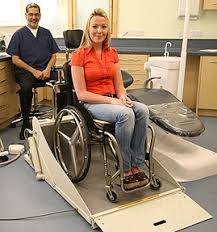
 The adjustable dental platform, the ramp allows the reclining of the wheelchair

 click on image to play video


Many of these problems may be overcome by the use of specially designed mobile dental platforms. Platforms such as DiacoTM are used routinely by the NHS in the UK and by certain clinics across the US, Asia and Australia. The unit consists of an adjustable ramp and an attached dental unit. The patient remains in the chair at all times. The chair is wheeled on to the ramp and the brakes are applied. The ramp is then adjusted to the optimal angulations permitting the dentist all the benefits of a conventional dental chair. These units however are expensive and thus their use in the Indian scenario is limited. Thus in most cases the dentist; in order to render optimal dental care is compelled to transfer the patient from the wheel chair to the dental chair.

Monday, January 5, 2009

Definition of a Special Patient

The Special Care Dentistry Association (SCDA) has proposed the following definition

The term "Special Patient" is used in the oral health field to describe an individual with special needs, including physical, medical, developmental and/or cognitive conditions, resulting in limitations in their ability to receive dental services and prevent oral diseases by maintaining daily oral hygiene.

The definition and other guidelines for the treatment of individuals with special care needs are being developed and will be published in the Journal of the SCDA, Special Care Dentist later this year. You can get the latest updates at www.scdaonline.org 

Thursday, January 1, 2009

Acess in Special Care Dentistry : Theory vs Practice


Dr Sharat Chandra Pani 

The care of a person with physical disability involves not only an understanding of the disability but also of the ways in which this disability can be overcome.  The biggest challenge an individual with disability faces is often one of accessibility.  

Accessibility refers to the ease with which everybody can approach, enter and use buildings, outdoor areas and other facilities, independently, without the need for any special arrangements. Accessibility is a feature that makes the environment user friendly and safe for all and not just the persons with disabilities. With respect to special care dentistry the term access also refers to the ability of the patient to obtain dental care. Several factors influence accessibility. The most common barriers faced by disabled people are physical inaccessibility of the premises and the staff’s lack of understanding of the needs of disabled patients. Accessibility does not only mean access for patients in wheelchairs, accessibility must also take into account the challenges faced by visually impaired or hearing impaired patients. DCSN looks at accessibilty in our Indian practices